Meditations on Synthetic Consciousness: The Start
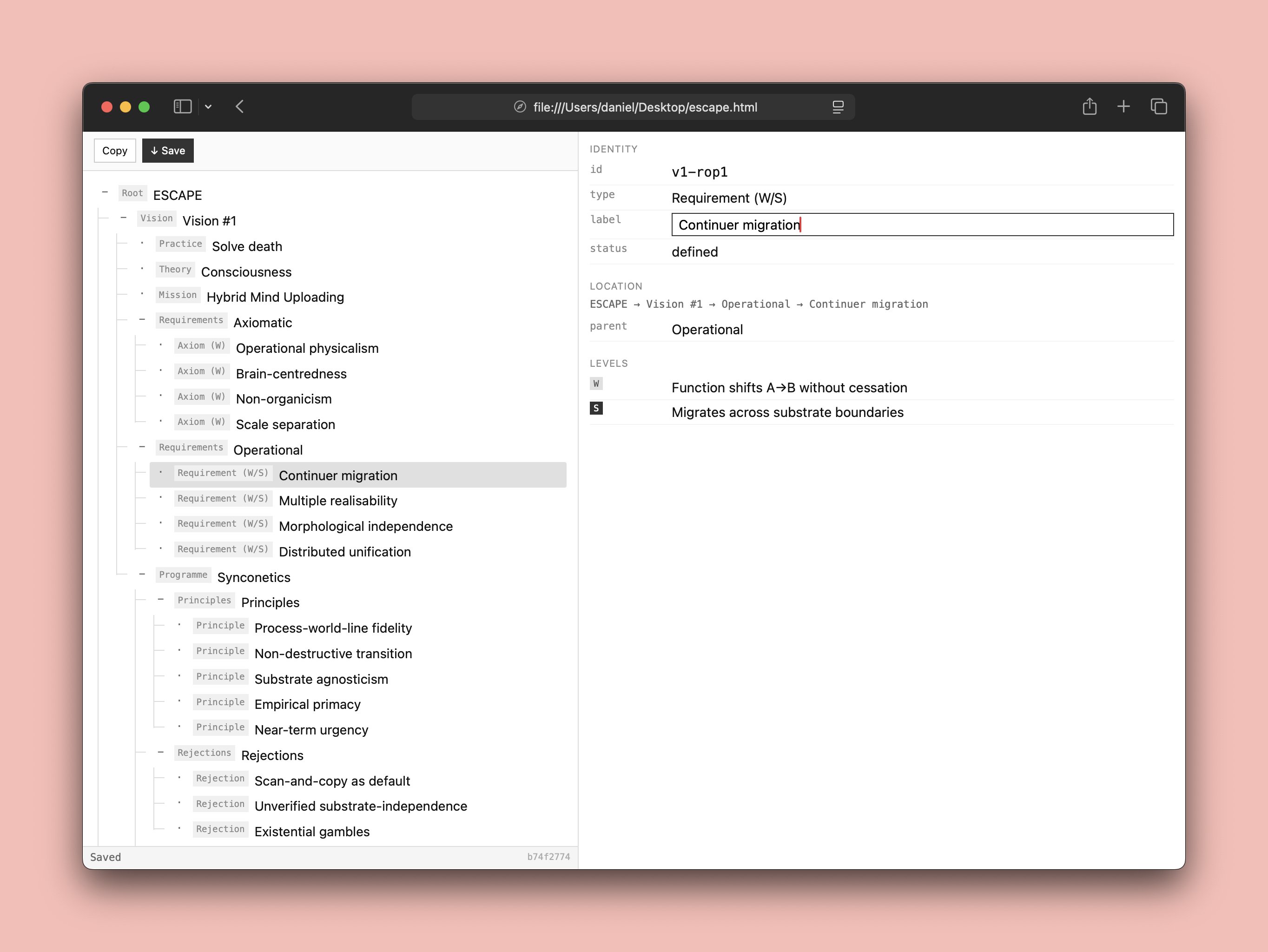
On the first day of this year, I created a small ontology editor (similar to, e.g. Protégé, just a lot simpler and without the formal OWL logic behind it) for the all-encompassing ontology* of my life and its vision, mission, goals, etc. It starts with the main vision (i.e. the future state of being I'm working towards), which is "synthetic consciousness". Simply summarised: engineered phenomenology on a designed substrate you could gradually become. I break it down into the mission, which is hybrid mind uploading (the most pragmatic way to achieve the same goals as classical mind uploading, just not by following the free-standing position of "creating something external to the brain that recreates the brain" but rather by building something that can be integrated into the thing at hand (i.e. your brain), hence the hybrid status in between. If you read some of my recent tweets, you'll know what I mean, as I've been talking about it in great detail + there's the upcoming manuscript on it. Then there are a few principles and rejections, some goals, one of which is quite practical: solve death (more on this below), and a few other things.
Btw, in September I already listed most of the terms I keep using and explained them in relation to each other ([Sep 2026]), but that was more of a glossary where the terms just stand side by side, whereas the ontology is a tree and therefore also says what sits under what. The tree itself is very pragmatic on purpose (I don't add text if it's not necessary; every word has a "right to exist"), which obviously also means that pretty much all the actual arguments behind those few words are either in my head, in old tweets and threads, or in manuscripts that aren't finished yet, and that's not really of much use to anyone but me...
So, as quickly described yesterday, I'm at Inkhaven (at Lighthaven) for the next 30 days anyway, and the plan is to work through the ontology and discuss (nearly) every item under the synthetic consciousness vision in public, one per day, as a meditation. I call them meditations in the sense of Descartes (Husserl picked that up again later with his Cartesian Meditations, e.g.), i.e. I write them in the first person and step by step, showing my thought process during writing, so that others as readers can go through it by themselves and see how I get to something (wrong turns included, I'll leave them in!), rather than just having to believe me. This makes everything a bit messier, but I do actually enjoy reading meditations myself, so here we go!
In every one of the meditations, I want to do two things basically. Obviously I have to argue for whatever the item claims, as the tree itself only states things (remember, every word has a right to exist, so there are no real arguments in there). But I also want to check the words themselves, i.e. what they're even supposed to mean, because terms like "continuer migration" or "world-line fidelity" can very easily sound a lot deeper than they are (a very Wittgensteinian worry), and whatever doesn't survive that has to go from the ontology again.
Here is a simple example of what I mean by this, using the goals as stated above for "solve death": Death, as I use it, is the irreversible end of the process world-line, the process world-line being the 4D trajectory of the physical-dynamical and organised bounded processes going on in your head that constitute what we call your brain. Not subscribing to any particular theory of consciousness basically lets you work with what you have at hand, which is the human brain, i.e. the main empirical object of investigation. The process itself starts at birth (technically slightly earlier, tbd) and ends when you die – it's one continuous thing (the "continuous" part can ofc also be attacked philosophically, more on that on the day we discuss it!). Either way, the premise: death is a contingent failure of the substrate. The move: swap the substrate out piece by piece without destroying the physical-dynamical and organised bounded processes – while hopefully introducing repairability/fault tolerance – so that the process hardens and becomes more resilient (i.e. the hardening of the process world-line).
Now, what I can actually argue for today is that the one biological brain you have keeps ageing and is therefore a single point of failure (= easy), and also that a different piece of brain can take over a function, as there's the serial lesion effect and Barrett's (2013) gradual reorganisation principle for that. What neither of them gives you is a different substrate taking over though, which is still open and basically the reason for the whole replacement work of ours at @synconeticsorg (so no, I can't argue for that part today). Also, "solved" doesn't mean immortal => the limits go from biological to "purely" physical ones, and the universe has plenty of those (heat death, eventually), so immortality is really its own question. Which makes me wonder if "solve" is even the right word for this goal? No idea yet tbh, we'll see when we get to it.
So the commitment for the next 30 days is one item of the ontology per day, as a public meditation here on my Twitter. Btw, nothing here is final, and some of it will change, as both the September list and the tree (OG tweet retweeted here => the screenshot) already have outdated bits, and if an item doesn't survive its own meditation, I'll rename it or throw it out and update the tree accordingly.
Tomorrow it's 1/30, which is the vision itself => synthetic consciousness! :-)
* PS: The term "ontology" might not be perfect or 100% correct here, it might be more of a taxonomy (or simply a hierarchy), i.e. from broad to small and well-defined, which is how the current version in my self-made editor works. However, I'd love to turn it more into a "what exists within a domain, plus the interconnections/relationships between those things and what follows from those relationships" (i.e. a proper ontology)