Meditations on Synthetic Consciousness: What Could Be Hybrid about Mind Uploading?
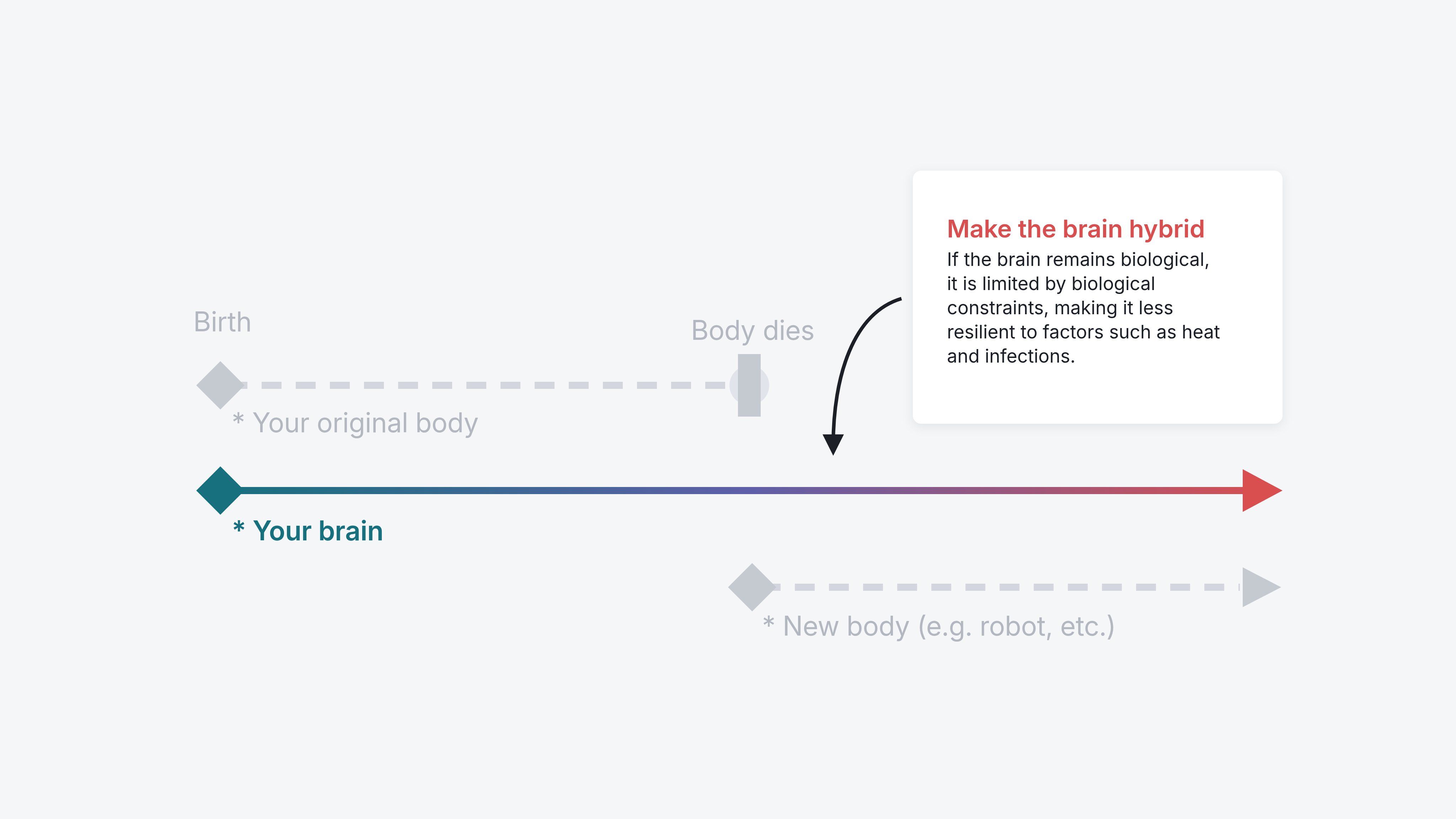
The next item in the Ontology is the mission, which, as I understand and use it, is the undertaking that leads to the vision (and "hybrid mind uploading" is its name), with the vision being a state of being in the future described as "there will be synthetic consciousness", as discussed in great detail yesterday ([Nov 2026]). One thing became quite clear yesterday: you cannot define a single item in the Ontology without first defining its relations to other items, which makes linear-style writing in a left-to-right language such as English quite hard without anticipating some of the other items in the Ontology. The one already mentioned was hybrid mind uploading.
It seems that, in order not to stay with naturally produced consciousness, due to all the things discussed yesterday (it's fragile, hence not resilient, and above all it has to end), but in order to go into a new state that is meant to continue the same process world-line, just no longer naturally produced, therefore "'something' consciousness", for which we used the term "synthetic" as in "the same kind, but created/engineered", the great focus has to be on the "well, what is the process?".
Over the past few years, I've been slowly coming out of the field of (classical) mind uploading ([Dec 2023], [Mar 2026], and, as the final push, [Nov 2026]). After I had defined it to be my life's mission to solve death (as described yesterday), I first thought that the most pragmatic way is to focus on consciousness as the most fundamental thing, and then try to preserve that with the most resilience and upshots to other things ("opportunities", as I called them yesterday), and that this would be mind uploading: scan a brain in as much detail as possible, store it somewhere and then simulate it in order to emulate consciousness on a different substrate, hence a computer. This is what I define as "classical mind uploading" nowadays, btw. So I was never technically interested in other forms of rejuvenation or gene therapies, because they don't focus on the first principles of death; they keep the process world-line within the limits of biology, and they don't address the full range of vulnerabilities I want to overcome.
Now, the problem with this classical approach as described before, as some of you might know if you've been following me on Twitter in the past few years (e.g. [Sep 2026] and [Sep 2026]), is that there are a bunch of issues, which I do not want to repeat again (I once called it "dying with extra steps": [Aug 2025]), especially because those rejections and criticisms are actually other Ontology items for the daily meditations challenge in the coming days.
The important story background here is that at some point, I wanted to distance myself completely from the "mind uploading" term, as I saw all the issues and wasn't even a fan of the terminology of "mind" and "uploading" on its own. What is a mind? What is uploading? (I'll keep both words for now btw, and the first question gets its answer in a later meditation) Uploading is so frontloaded with computer science terminology, and to be fair, a term that's borrowed from another discipline isn't a problem by itself; it only becomes one when its familiar use quietly decides what has to be true in the new discipline as well, so in the minds of the researchers and people (Wittgenstein style again). I was obviously not the first person to have issues with this; afaik @randalkoene had similar concerns, and around 1998 he named the academic approach "whole brain emulation". "Mind uploading" came down from the Hans Moravec lineage, front-loaded with even more sci-fi connotations, which might be a net negative for a scientific, serious discipline.
Now, I thought that "whole brain emulation" is a great term (Randal Koene later also used "substrate-independent minds" btw), so I was looking into terming the mission with something around it, e.g. candidates such as "invariant brain emulation" ([Jun 2025]), in order to imply other aspects of the Ontology, e.g. that the thing we want to recreate has no self-standing position, but actually integrates into the brain at hand, and also that the process world-line doesn't break, and other things (as late as April this year I still called myself "a WBE person, but not via simulations": [Apr 2026]). But I had a few issues with that. Why WHOLE? What does this mean? It already implies "just" the brain to a certain degree; therefore, some degree of brain-centredness of consciousness, which might be too much of a leap of faith already. Also, brain? Why just the brain? Even more brain-centredness (and yes, I'm aware that the slide in my own Ontology says "make the brain hybrid", but the brain is where we start, and that's no claim about where consciousness has to live). And emulation? Emulation is, I guess, an even worse ambiguous term than uploading, because emulation is mostly understood as JUST a software term (which it doesn't have to be btw: [Jun 2025]), and based on my own experience it's actually sometimes used interchangeably with simulation. So I ran into a few issues with terming this mission item in the Ontology.
After a few years, I basically realised, especially when starting to pitch this to a few people, friends, investors, that using a neologism is bad, as it's front-loaded with too much abstraction. I always admired pitches of people who could just use "XYZ but for XYZ", so using something familiar and then mapping it, e.g. onto your problem space. At some point, I remember, I realised that actually "mind uploading" is a great term, as it implies, even for most people who are not in the space at all, things such as "immortality, solving death, mind augmentation and enabling a new state of humanity" and a few more. I liked that, after all. And before somebody calls that a double standard, as "uploading" is obviously a computer science term too: I keep the word for what it promises, and I drop its old method, meaning that with hybrid mind uploading I don't mean reconstructing a separate instance somewhere and then treating that copy as my survival.
But I did not like the immediate association with mind uploading being a subdiscipline of computer science and nowadays AI, and that it's mostly, and nearly only if you look at the literature (look at previous posts here: [Sep 2026] and here: [Sep 2026]), used for "scan, store, simulate" => all engineering efforts are within "recreating a self-standing brain from brain scans, sometimes even fully destructive". So the process world-line discussion rarely came up, and never at the centre, and the aspect of knowing if a simulation will be sufficient for a full emulation, or if it's even able to have phenomenal consciousness, is a recurring issue (e.g. [Feb 2026], and something more to discuss in the meditation where I'll discuss the Synconetics programme in the coming days).
So I thought of "moving the original goals of mind uploading, which are solving death, mind augmentation and enabling a new state of humanity", as e.g. popularised in the Hans Moravec lineage (Moravec's own robot-surgeon procedure in "Mind Children" from 1988 was already a gradual one btw, but its end state was still the mind as a computer program), from it being a subdiscipline of CS and AI into a discipline(s) with fewer metaphysical claims and assumptions (so fewer metaphysical commitments, and ones that experiments can at least bear on, and not zero, as the process world-line is still one of them), and to make the remaining assumptions explicit and investigate them, instead of taking leaps of faith ([Oct 2025], and for the functionalism part of it [Apr 2026] and [Jul 2026]). So I denoted whatever mind uploading via whole brain emulation used to be as "classical mind uploading", and whatever is new as "XYZ mind uploading".
Now the question was: what term to use for XYZ? As the idea (one of many ideas, as you will see in the coming days as well) is to go through/via a hybrid state of the thing that carries the process world-line into the synthetic consciousness state as the causa finalis, we will enter a hybrid state on the way from whatever was the starting point (i.e. biologically sustained consciousness) to the end state (synthetically sustained consciousness). Hence: hybrid ([Jul 2026]). And to answer the question from the title as well: by "hybrid" I mean that biological and engineered parts are carrying one and the same process at the same time, so the thing that is hybrid is what carries the consciousness, and never the consciousness itself (so please don't picture some "half-synthetic" experience here, as synthetic means the same kind, see yesterday). It's actually that simple. And by "process world-line" I mean a physical claim about the process itself that does the carrying, and not a report of "how continuous it feels" => as a copy would feel continuous too! And if this particular consciousness really gets preserved via that transition is the aim of the whole mission, and nothing that the word "hybrid" could establish by itself (if the hybrid state is only a passage, or if somebody could also just stay hybrid, is a question for another day as well). But for today I can only say this: I call the consciousness "synthetic" once it's sustained by created and engineered parts, and whether the hybrid state already counts as that is exactly the question I'm leaving open (at least for now).
What this all implies, and all the issues that I have with classical mind uploading, and what assumptions and axioms we still have in hybrid mind uploading, is part of the Ontology when we go down in more detail, and therefore part of another day (and for those who can't wait: the post distinguishing classical from hybrid [Mar 2026], the river as the border between the two [May 2026], "The Alien Neuron" [Sep 2026], and why it's harder than classical, but better [Oct 2026]).